

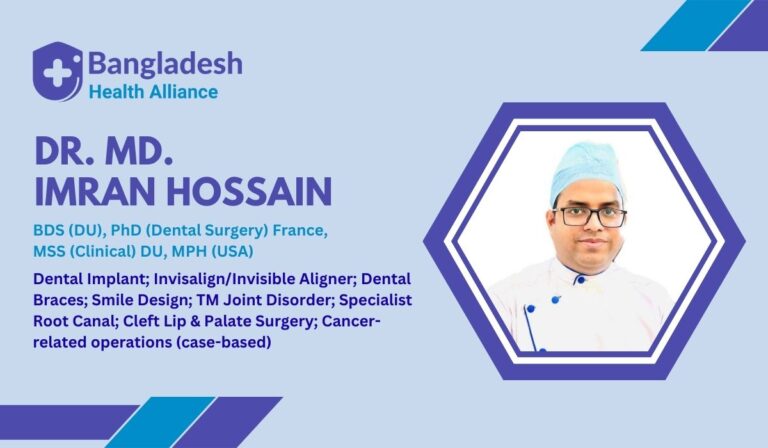
Dr. Md. Imran Hossain — Dental Implant, Invisalign & Orthodontic Dental Surgery Specialist in Banani, Dhaka
If you’re searching for a dental implant doctor in Dhaka, planning Invisalign / invisible aligner treatment, or need a trusted specialist for dental braces, smile design, TMJ (jaw joint) problems, root canal care, or complex surgical dental support, Dr. Md. Imran Hossain serves patients at Dental View Orthodontics & Implant Center, Banani, Dhaka.
He is known for combining strong academic training with advanced international exposure in implant surgery, aligner therapy, orthodontics, and surgical dentistry—so patients can receive modern, step-by-step care with clear explanations.
Quick Facts for Patients
- Dr. Md. Imran Hossain
- BDS (DU), PhD (Dental Surgery) France, MSS (Clinical) DU, MPH (USA)
- Implant Surgery and Invisible Aligner (London, UK)
- PGT (Orthodontic), PGT (OMS) BSMMU, Research Fellow & Surgeon (STRC Project, Smile Train, USA)
- Advanced Implantology (Thailand), Invisalign (Thailand & India)
- Advance Training in Fixed Orthodontic Braces, Implantology & Laser Dentistry (India)
- Chief Consultant, Dental Surgery, Dental View Orthodontics & Implant Center
- Special Focus on Dental Implant, Invisalign / Clear Aligners, Dental Braces, Smile Design, TM Joint Disorder, Specialist Root Canal, Cleft Lip & Palate Surgery, Cancer-related Operations (case-based)
- Chamber: Dental View Orthodontics & Implant Center
- Address: House # 67/C, Road # 11, Block # E, Banani, Dhaka-1213
- Visiting Hours: 10:00 AM – 9:30 PM (Everyday)
- Appointment: +8801789280929
Note: Opening hours may vary by day/holiday—calling ahead is best. (Dental View’s official site mentions daily opening hours and the same Banani address/phone.)
Why This Profile Matters for Bangladeshi Patients
Oral health problems are extremely common in Bangladesh—and they often become serious simply because people wait too long. The WHO oral health country profile for Bangladesh estimates a large burden of untreated tooth decay and severe gum disease across age groups.
That’s why a patient-first approach matters: the right diagnosis, a realistic plan, and early treatment can reduce pain, infection risk, chewing problems, and long-term cost.
For many families—whether in Dhaka city or coming from outside Dhaka—three things make a difference:
- Clear explanation in simple language
- A treatment plan that matches budget and urgency
- Follow-up guidance (what to eat, how to clean, when to return)
This is the type of structured, step-by-step care patients typically look for in a dentist in Banani or a dental implant specialist in Dhaka.
About Dr. Md. Imran Hossain
Dr. Md. Imran Hossain works as a Chief Consultant in Dental Surgery and provides services that cover both advanced restorative dentistry (like implants and smile design) and orthodontic solutions (like Invisalign/clear aligners and braces), along with surgical dental care (including cleft-related work, based on case need and referral pathways).
What patients usually value in a specialist profile like this is not just “what treatments are offered,” but how decisions are made. In modern dentistry, the best results often come from:
- careful diagnosis (clinical exam + appropriate imaging),
- realistic expectations,
- hygiene and gum stability before high-end procedures,
- and proper aftercare.
Educational Qualifications
Dr. Md. Imran Hossain’s academic background includes:
- BDS (DU)
- MSS (Clinical) — University of Dhaka (DU)
- MPH (USA)
- PhD (Dental Surgery) — France
This combination can be meaningful for patients because it blends:
- clinical dental training (BDS + clinical postgraduate learning),
- research/academic depth (PhD pathway),
- and population health thinking (MPH)—useful for prevention-focused counseling, infection control awareness, and long-term outcome planning.
Advanced Training & International Exposure
Your provided credentials indicate multiple advanced trainings across countries and institutions, including:
- Implant Surgery and Invisible Aligner training (London, UK)
- PGT (Orthodontic), PGT (OMS) — BSMMU
- Research Fellow & Surgeon — STRC Project, Smile Train, USA (as provided)
- Advanced Implantology (Thailand)
- Invisalign training (Thailand & India)
- Advanced training in fixed orthodontic braces, implantology & laser dentistry (India)
Why international training can matter (in simple terms)
For patients, these training experiences often translate into:
- updated protocols for implant planning,
- better case selection (who is suitable for aligners vs braces),
- attention to bite function (not only “straight teeth”),
- and safer step-by-step surgical planning for complex conditions.
For cleft care, Smile Train is widely known for supporting comprehensive cleft care and professional training that strengthens local capacity.
Services & Treatment Areas
Below are the key services mentioned in your input—explained in a way that helps patients understand what they’re booking for.
1) Dental Implant (Implant Dentistry in Dhaka)
A dental implant is often chosen when a tooth is missing or needs extraction and a fixed replacement is preferred.
Common reasons people search “dental implant specialist in Banani / Dhaka”
- missing tooth affecting chewing
- loose denture problems
- broken tooth that cannot be saved
- desire for a long-term fixed solution
A typical implant journey (easy explanation)
- Assessment & planning: gum health, bone support, bite check, and imaging
- Implant placement: a titanium implant placed in bone (case-dependent)
- Healing period: time needed for integration (varies by patient)
- Crown/bridge fitting: final tooth made and adjusted to bite
Important safety note (patient education):
Implants are not “one-day magic for everyone.” Uncontrolled diabetes, smoking, untreated gum disease, and poor oral hygiene can reduce success and increase complications. A good clinician will first stabilize gums and plan properly—especially for complex cases.
2) Invisalign / Clear Aligners (Invisible Aligner in Dhaka)
For many adults and teens, Invisalign or clear aligner therapy is popular because it is less visible and removable.
The most important success factor: wear time
Medical literature and Invisalign’s own guidance commonly cite that aligners typically need about 20–22 hours/day wear for best outcomes, and lack of compliance can prolong treatment or reduce effectiveness.
Who may benefit most
- mild to moderate crowding/spacing
- patients who want discreet orthodontics
- people who can follow wear-time discipline
Who may need extra evaluation
- severe bite issues or complex tooth movements
- untreated gum disease
- people who cannot commit to daily wear time
A consultation is essential to determine whether clear aligners or fixed braces will be safer and more predictable.
3) Dental Braces (Fixed Orthodontic Braces in Banani)
Braces remain a powerful option—especially when tooth movements are complex.
Patients often ask: “How long will braces take?”
Duration depends on crowding, bite correction, age, and oral hygiene. In many cases it ranges from months to a couple of years, but the most accurate answer comes only after a proper orthodontic assessment.
Practical braces tips for Bangladeshi families
- brushing after meals is important (food traps increase decay risk)
- regular follow-up visits prevent wire/bite issues from becoming bigger problems
- if gum bleeding increases, don’t ignore it—get cleaning and hygiene guidance early
4) Smile Design / Smile Makeover (Cosmetic + Functional Dentistry)
“Smile design” is not only about white teeth—it’s about balance:
- how teeth look in photos
- how lips frame the smile
- and how bite function protects teeth from chipping and jaw strain
A quality smile design plan usually starts with:
- gum health check
- bite assessment (function)
- alignment options (aligners/braces) if needed
- restorative steps (veneers/crowns/bonding) when appropriate
A patient-first clinic typically explains:
- what will change,
- what will not change,
- and how to maintain results long-term.
5) TM Joint Disorder (TMJ) — Jaw Pain, Clicking, Headache
Many people search “TMJ treatment in Dhaka” because they have:
- jaw clicking or locking
- pain near ear or jaw joint
- morning jaw stiffness
- headaches related to clenching/grinding
Common contributors
- bite imbalance
- stress-related clenching
- missing teeth affecting chewing balance
- long-term gum/tooth problems that change bite
What patients can expect
TMJ care often starts conservatively—education, bite evaluation, sometimes splint guidance, and addressing trigger factors. If needed, a more advanced approach is planned based on the individual case.
6) Specialist Root Canal (Endodontic Care)
A root canal is usually needed when the tooth nerve is infected or severely inflamed.
Signs you may need evaluation
- lingering tooth pain to hot/cold
- pain when biting
- swelling or gum pimple near a tooth
- deep cavity or old filling with recurrent pain
Important patient truth:
A root canal often saves a natural tooth, but it also needs proper restoration afterward (commonly a crown/cap depending on the tooth) to reduce fracture risk.
7) Cleft Lip & Palate Surgery (Cleft Care Pathway)
Cleft conditions require structured care and follow-up. Your input mentions involvement with Smile Train-related work. Smile Train is known globally for supporting comprehensive cleft care and training local medical professionals.
Patient note (important):
Cleft care is typically multidisciplinary (surgery + dental/orthodontic + speech + nutrition support). A specialist’s role may vary by case and center—so evaluation and referral coordination matter.
8) Cancer-related Operations (Oral/Facial, Case-Based)
When people say “cancer operation” in a dental surgery context, it often refers to oral/maxillofacial surgical support such as biopsy guidance, surgical planning, and rehabilitation pathways—usually coordinated with larger hospital teams.
Patient safety note:
Any suspected oral cancer sign (non-healing ulcer, unusual lump, persistent pain, difficulty swallowing, unexplained bleeding) should be evaluated early and referred appropriately—early detection can be life-changing.
What Patients Can Expect at Dental View Orthodontics & Implant Center (Banani)
Choosing a dentist is not only about “treatment availability.” Patients usually want:
- a respectful environment,
- clear communication,
- and transparent planning.
A typical patient journey
- Registration & history: medical conditions, medications, previous dental work
- Clinical exam: teeth, gums, bite, jaw joint
- Investigation (if needed): X-ray/scan planning
- Diagnosis explained in simple terms
- Treatment plan with options: best option + alternative options
- Cost discussion: phased approach when needed
- Procedure & aftercare instructions
- Follow-up: adjustments, hygiene checks, retainers (for aligners/braces), maintenance visits
Why prevention is emphasized
Many dental problems in Bangladesh become expensive simply because they were treated late. WHO-based estimates show untreated decay and gum disease remain common—meaning prevention and early intervention should be part of every consultation, not an afterthought.
Clinic Location, Visiting Hours & Appointment
Dental View Orthodontics & Implant Center
Address: House No # 67/C, Road # 11, Block # E, Banani, Dhaka-1213
Visiting Hours (as provided): 10:00 AM – 9:30 PM (Everyday)
Appointment: +8801789280929
Tip for patients coming from outside Dhaka:
If you’re traveling from another district, call before you start your journey. Ask what documents to bring (previous X-rays, prescriptions, old dental caps/bridges history), and request the best visiting time to reduce waiting.
Practical Patient Guidance (Especially Helpful for Rural & Busy Families)
What to bring to your first visit
- a list of medicines (diabetes, blood pressure, blood thinner, etc.)
- any previous dental X-rays or reports
- if you have aligners/braces from elsewhere, bring them too
- if you have chronic illness: last 3–6 months relevant reports (if available)
What to ask during your consultation (simple checklist)
- “What is the diagnosis in simple words?”
- “What are my treatment options and which one is best for long-term?”
- “How many visits are needed?”
- “What is the aftercare and follow-up schedule?”
- “What happens if I delay treatment?”
Oral hygiene basics that prevent repeat treatment
- brush twice daily with fluoride toothpaste
- clean between teeth (floss/interdental brush)
- reduce frequent sugary snacks/tea with sugar
- don’t ignore gum bleeding (it’s a sign, not “normal”)
Consultation Fee & Online Consultation
- Online Consultation: Available via WhatsApp / Imo / Google Meet through Dental View’s official e-consultation system.
- Online Consultation Fee: BDT 1200
- Payment Method: bKash Personal — 01675455130
- Official e-consultation page: https://dentalviewbd.com/e-consultation/
- Chamber Appointment (In-person serial): +8801789280929
Patient safety note: Before sending payment, patients should confirm the current fee and payment instructions by calling the clinic or checking the official e-consultation page, especially during holidays or schedule changes.
Why People Choose a Banani Dental Specialist for Complex Treatments
For procedures like implants, Invisalign, braces, smile design, TMJ care, and advanced surgery-related planning, patients often prefer a center that can offer:
- modern diagnostics and planning,
- structured follow-up schedules,
- and a team approach when needed.
That’s especially true for aligners—because success depends heavily on consistent wear time and regular monitoring.
FAQs
Is Dr. Md. Imran Hossain a good choice for dental implants in Dhaka?
If you want dental implants in Dhaka with advanced planning and follow-up, he’s a relevant choice—especially for implant-focused cases and cosmetic-functional restoration planning.
For the best outcome, your suitability depends on gum health, bone support, and medical history (diabetes, smoking, etc.). A proper assessment decides whether you need a straightforward implant, grafting, or a staged plan.
Can I get a dental implant if I have diabetes or high blood pressure?
Often yes—but only if your condition is controlled and your dentist plans it safely.
Most patients with diabetes or hypertension can still receive implants, but success depends on:
- controlled blood sugar / blood pressure
- healthy gums (no untreated infection)
- good oral hygiene + follow-up visits
Always tell the clinic your medicines and recent reports before any procedure.
How long does a dental implant take to heal before the crown is placed?
Many patients need a healing period of a few months before the final crown—because the implant must fuse with the bone (osseointegration). (Pickering Smile Centre)
Your timeline varies based on bone quality, infection history, and whether additional procedures are needed.
Is Invisalign (clear aligners) better than braces?
It depends on your case—aligners are great for discreet treatment, but braces can be more predictable for complex bite corrections.
A safe decision is usually based on:
- severity of crowding/spacing
- bite issues (overbite/underbite/crossbite)
- gum health
- how disciplined you can be with wear time
How many hours a day do I need to wear clear aligners?
Typically, aligners should be worn about 20–22 hours/day for best results—only removing for eating and cleaning. (Invisalign)
If you wear them less, treatment may take longer and results can become less predictable—so consistency matters.
What foods should I avoid with braces?
Avoid hard, sticky, and very crunchy foods—because they can break brackets/wires and delay treatment.
Common “problem foods” in Bangladesh:
- hard candies, ice, nuts
- sticky sweets, chewing gum
- very hard fried snacks
Tip: cut fruits/meat into small pieces and chew carefully—especially in the first weeks.
My jaw clicks or hurts—could it be TMJ? When should I see a dentist?
Jaw clicking with pain, limited opening, or headaches can be TMJ-related—get evaluated if it lasts more than 2–3 weeks or is worsening.
Seek help sooner if you have:
- jaw locking (stuck open/closed)
- severe pain near the ear/joint
- chewing discomfort that’s increasing
Early conservative care and bite evaluation can prevent long-term discomfort.
Do I need a root canal, or can a filling fix it?
If pain lingers to hot/cold, you feel pain on biting, or there’s swelling/pus—root canal evaluation is usually needed.
A filling may work for shallow decay, but once the nerve is infected/inflamed, delaying treatment can increase infection risk and pain episodes.
After a root canal, do I still need a crown (cap)?
Often yes—especially for back teeth—because the tooth can become weaker and more likely to crack.
Your dentist decides based on:
- which tooth it is (front vs molar)
- how much tooth structure remains
- bite force and habits (clenching/grinding)
What are warning signs of oral (mouth) cancer that I shouldn’t ignore?
A mouth ulcer that doesn’t heal in 3 weeks, a persistent lump, red/white patches, or pain that doesn’t go away should be checked promptly. (nhs.uk)
Dentists can guide evaluation and referral. Early checking is always safer than waiting.
Call to Book an Appointment
To consult Dr. Md. Imran Hossain at Dental View Orthodontics & Implant Center, Banani, call:
- 📞 Appointment: +8801789280929
- 🕒 Visiting hours (as provided): 10:00 AM – 9:30 PM (Everyday)
- 📍 Banani, Dhaka-1213 (House #67/C, Road #11, Block #E)