

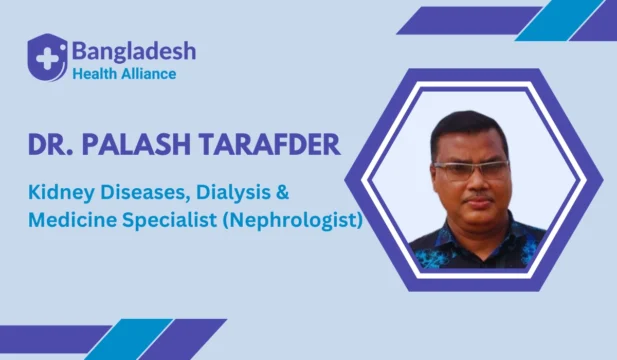
Prof. Dr. Palash Tarafder — Kidney (Nephrology), Dialysis & Medicine Specialist in Khulna
If you are looking for a kidney specialist in Khulna who can explain your reports clearly, guide you step-by-step, and help you make confident decisions about long-term kidney care, Prof. Dr. Palash Tarafder is a well-known name in nephrology practice in Khulna. With 15 years of experience and advanced training in Nephrology (MD), he supports patients dealing with kidney disease, dialysis-related care, and internal medicine concerns that often overlap with kidney health—such as blood pressure, diabetes, swelling, and electrolyte imbalance.
He is associated with Khulna Medical College & Hospital, where he serves in the Nephrology department. Alongside his government/academic work, he also consults patients privately in Khulna—making specialist kidney care more accessible to families across Khulna city and nearby districts.
Quick appointment shortcut (Khulna): Call +8801934-998688 for serial.
At a Glance
- Name: Prof. Dr. Palash Tarafder
- Specialty: Kidney Diseases (Nephrology), Dialysis Care, Medicine
- Workplace: Khulna Medical College & Hospital
- Experience: 15 Years
- BM&DC Registration: A-42563
- Private Chamber: Citizen Lab Doctor & Diagnostic, Khulna
- Visiting Hours: 02:00 PM – 03:30 PM (Closed: Friday)
- Fees: First Visit ৳800 | Follow-up/2nd Visit ৳600
- Chamber Address: 22 KDA Avenue, Islam Tower, Moylapota Mor, Khulna-9100, Bangladesh
Professional Overview
Kidney problems can feel confusing because they often develop quietly and show up only in lab reports: creatinine going up, urine protein appearing, swelling in the legs, or blood pressure becoming hard to control. Many patients arrive with a file full of reports but no clear explanation of what the numbers actually mean.
Prof. Dr. Palash Tarafder’s practice style is built around clarity and long-term planning—especially for patients who need ongoing follow-up. In nephrology, early decisions can affect the next five or ten years: medication safety, diet changes, diabetes and blood pressure targets, and timely preparation if dialysis ever becomes necessary.
When patients meet him for the first time, the usual goals are:
- Understanding the cause of kidney dysfunction (not just “creatinine is high”).
- Identifying reversible factors (dehydration, infection, medicine side effects, obstruction, uncontrolled BP/diabetes).
- Creating a realistic care plan for monitoring, lifestyle, and medicines.
- Planning for dialysis only if and when it is needed—without panic, and with proper preparation.
For deeper patient education on kidney disease and how it progresses, these references are useful:
Qualifications / Education
Prof. Dr. Palash Tarafder’s training includes:
- MBBS — Bachelor of Medicine and Bachelor of Surgery
- BCS (Health) — Bangladesh Civil Service (Health)
- MD (Nephrology) — Doctor of Medicine in Nephrology
These credentials reflect both a strong clinical foundation (MBBS) and specialized nephrology expertise (MD), combined with public healthcare service experience (BCS Health).
Board Certifications / Professional Registrations
- Bangladesh Medical & Dental Council (BM&DC) Registration: A-42563
BM&DC registration is an important indicator of verified professional licensing and accountability in Bangladesh.
Designation, Department & Workplace
- Department: Nephrology
- Workplace: Khulna Medical College & Hospital
- Role: Senior academic/department leadership role in nephrology (as listed in his current profile).
For patients, this matters because a doctor working in a major government teaching hospital typically manages a wide range of complex kidney cases—from early-stage CKD to dialysis care and urgent kidney complications.
If you want to explore other specialists and services connected to his workplace, see:
Clinical Focus: What Patients Commonly See Him For
Nephrologists often work at the intersection of kidney disease and internal medicine. In real life, that means many patients come with symptoms that look “general,” but are actually kidney-related.
Patients commonly consult Prof. Dr. Palash Tarafder for:
- Chronic Kidney Disease (CKD) evaluation and follow-up
- Acute Kidney Injury (AKI) and sudden creatinine rise (when appropriate for nephrology)
- Diabetic kidney disease (diabetes + rising creatinine / urine albumin)
- Hypertension with kidney involvement (hard-to-control blood pressure)
- Protein/albumin in urine (urine ACR abnormalities)
- Swelling (edema) of legs/face, especially with urine protein or low albumin
- Electrolyte imbalance (sodium/potassium disturbances)
- Kidney inflammation (suspected glomerulonephritis) and urine abnormalities
- Dialysis counseling, planning, and ongoing monitoring for dialysis patients
For background reading (patient-friendly):
Conditions Treated (Disease/Problems)
Below is a practical list of kidney and kidney-related medical problems that nephrology specialists routinely manage. This section is written from a patient intent perspective—so you can quickly match your report/symptoms to a reason for visiting.
Kidney disease and abnormal lab reports
- High creatinine / low eGFR (repeated abnormal kidney function tests)
- Persistent protein/albumin in urine
- Blood in urine (hematuria) when linked to kidney causes
- Recurrent electrolyte abnormalities (e.g., high potassium)
Long-term kidney conditions
- Chronic Kidney Disease (CKD) (early to advanced stages)
- Diabetic kidney disease
- Hypertension-related kidney damage
- Polycystic kidney disease (suspected or diagnosed)
Inflammatory/immune-related kidney conditions
- Glomerulonephritis (suspected)
- Nephrotic syndrome (severe protein loss in urine)
Dialysis-related care
- Pre-dialysis counseling (when kidney function is declining)
- Hemodialysis / dialysis follow-up (fluid, BP, anemia & bone-mineral risks)
Note: Some conditions (like kidney stones or obstruction) may involve both nephrology and urology depending on the exact issue. If surgery-focused urinary care is needed, BHA’s urology page can help: Urology specialists in Khulna
Procedures Performed / Services (Nephrology Scope)
Kidney specialists often perform fewer “surgical” procedures and more diagnostic interpretation + long-term medical management. In a real-world nephrology chamber, the most valuable “procedure” is a careful plan based on your reports.
Prof. Dr. Palash Tarafder’s kidney-care services typically include:
- Comprehensive kidney evaluation (history, exam, report review)
- Risk stratification and CKD staging guidance (monitoring schedule + prevention)
- Medication optimization (kidney-safe choices; dose adjustment if needed)
- Blood pressure strategy for kidney protection
- Diabetes-kidney coordination (treatment goals; risk reduction)
- Dialysis counseling & preparation (when required)
- Ongoing dialysis patient monitoring and complication prevention guidance
Dialysis education (patient-friendly):
Why Patients Choose a Nephrologist Early (Not Only for Dialysis)
A common myth is: “Kidney doctor means dialysis doctor.” In fact, nephrologists aim to delay or prevent kidney failure whenever possible and help patients live well with stable kidney function.
People benefit from early nephrology care when:
- Creatinine is rising over time
- Urine shows protein/albumin repeatedly
- Blood pressure remains high despite treatment
- Diabetes is long-standing and kidney markers worsen
- Swelling, breathlessness, or recurrent fluid retention appears
- Electrolytes (especially potassium) are abnormal
International guidance emphasizes early detection, risk-based monitoring, and protecting kidney function through BP/diabetes control and medication safety. If you want the technical guideline reference, see:
What to Expect in Your First Visit (Practical Walkthrough)
Most first visits follow a simple structure:
- Symptom and history review
- Timing of report changes
- Diabetes/BP history, infections, urinary symptoms
- Family history of kidney disease
- Medication safety check
Many patients unknowingly take medicines that can worsen kidney function—especially painkillers (NSAIDs) or herbal mixtures. The goal is not blame, but safety. - Report interpretation
Your doctor may focus on:
- Creatinine trends
- eGFR pattern
- Urine protein/ACR
- BP readings
- Ultrasound findings (kidney size/obstruction)
- Personalized plan
- What to monitor next
- What to change now (diet/fluids/medicine)
- When to come back
Tip: If your reports include “eGFR,” the National Kidney Foundation’s explanation is easy to understand: Understanding eGFR (NKF)
“Bring These” Checklist (So the Visit Is More Useful)
Bring any available:
- Creatinine/eGFR reports (preferably last 6–12 months)
- Urine routine + urine ACR/protein report
- BP log (home readings if you have)
- Diabetes reports (HbA1c, fasting/post-meal sugar)
- Ultrasound of KUB / urinary system (if done)
- A list (or photos) of current medicines + supplements
When patients bring these items, the plan becomes much clearer—often in a single visit.
Patient-Centered Care Values (What “Good Kidney Care” Looks Like)
In chronic conditions, patients need more than prescriptions—they need a system.
Prof. Dr. Palash Tarafder’s care philosophy (as reflected in how nephrology follow-up typically works) aligns with these patient-centered priorities:
- Clear explanations without unnecessary fear
- Step-by-step planning instead of sudden decisions
- Safety-first prescribing (kidney-safe medicine choices)
- Shared decision-making with patients and family
- Respect and privacy, especially for long-term dialysis planning
Clinic Hours (Chamber Schedule) — Citizen Lab Doctor & Diagnostic, Khulna
- Chamber: Citizen Lab Doctor & Diagnostic, Khulna
- Visiting Hours: 02:00 PM – 03:30 PM (Closed: Friday)
- Consultation Fees: First Visit ৳800 | Follow-up/2nd Visit ৳600
- Address: 22 KDA Avenue, Islam Tower, Moylapota Mor, Khulna-9100, Bangladesh
- Appointment (Serial): +8801934-998688
If you are exploring more nephrologists in Khulna for a second opinion or family member, you can also browse:
Online Consultation
Online consultation availability may vary by schedule and platform. For the most accurate information, please call the serial number and ask whether telemedicine is available for your case.
When You Should Seek Urgent Care (Safety Note)
This profile is for information and appointment guidance—it is not a replacement for emergency care.
Seek urgent care immediately if you have:
- Severe shortness of breath
- Chest pain
- Confusion or fainting
- Severe weakness with very low urine output
- Sudden swelling with breathing difficulty
How to Book an Appointment with Prof. Dr. Palash Tarafder
- Call +8801934-998688
- Say your main problem briefly (e.g., “high creatinine,” “protein in urine,” “dialysis follow-up,” “BP not controlled”)
- Ask what reports to bring and confirm chamber time
What is Prof. Dr. Palash Tarafder’s appointment number in Khulna?
Prof. Dr. Palash Tarafder’s serial/appointment number is +8801934-998688. Call to confirm the next available serial and what reports to bring for your visit.
Where is Prof. Dr. Palash Tarafder’s chamber in Khulna?
He consults privately at Citizen Lab Doctor & Diagnostic, Khulna, located at 22 KDA Avenue, Islam Tower, Moylapota Mor, Khulna-9100. View Citizen Lab Doctor & Diagnostic, Khulna chamber details on BHA.
What are Prof. Dr. Palash Tarafder’s visiting hours?
At Citizen Lab Doctor & Diagnostic, his visiting time is 02:00 PM – 03:30 PM, and the chamber is closed on Friday.
How much is the consultation fee for Prof. Dr. Palash Tarafder?
The consultation fee is ৳800 for the first visit and ৳600 for follow-up/2nd visit (Khulna chamber).
How do I book a serial faster when calling?
When you call, mention your main issue in one line—such as “high creatinine,” “protein in urine,” “swelling,” “dialysis follow-up,” or “BP not controlled.” Then confirm the chamber time and any required investigations.
Who is Prof. Dr. Palash Tarafder?
Prof. Dr. Palash Tarafder is a Kidney (Nephrology), Dialysis & Medicine Specialist in Khulna with 15 years of experience. He is associated with Khulna Medical College & Hospital and provides private consultations at Citizen Lab Doctor & Diagnostic.
Is Prof. Dr. Palash Tarafder a nephrologist (kidney specialist)?
Yes. He is trained in Nephrology (MD) and treats kidney diseases, dialysis-related care, and medical problems that impact kidney health.
What types of patients usually consult him?
Patients commonly consult for CKD (chronic kidney disease), high creatinine, protein/albumin in urine, swelling (edema), hypertension with kidney problems, and dialysis planning/follow-up.
When should I see a kidney specialist instead of a general doctor?
You should see a nephrologist if creatinine is rising, urine protein persists, blood pressure stays high despite treatment, or you have swelling with abnormal kidney tests. Evidence-based CKD monitoring guidance is summarized in the KDIGO 2024 CKD guideline.
Does he treat dialysis patients?
Yes. Kidney specialists often manage dialysis patients by monitoring fluid balance, BP, anemia risks, and complications. For patient basics, see the NHS guide to dialysis.
What reports should I bring for my first visit?
Bring creatinine/eGFR reports (recent + old), urine routine/ACR if available, BP readings, diabetes reports (HbA1c), ultrasound KUB (if done), and a list of current medicines.
My creatinine is high—what does that usually mean?
High creatinine can reflect reduced kidney filtration, dehydration, infection, medication effects, or chronic kidney disease. A nephrologist reviews trends and urine findings to identify the cause. See a patient-friendly overview from NIDDK on Chronic Kidney Disease (CKD).
I have protein in urine—should I be worried?
Persistent protein/albumin in urine can signal kidney damage or inflammation and may increase long-term risk if untreated. Early evaluation helps plan monitoring and kidney protection.
Can high blood pressure damage my kidneys?
Yes. Hypertension can both cause and worsen kidney disease, and kidney disease can make BP harder to control. Reference: WHO hypertension fact sheet.
Can diabetes affect the kidneys even if I feel fine?
Yes. Diabetic kidney disease can progress silently for years. Regular monitoring of urine albumin and kidney function helps detect changes early.
What time does Dr Palash Tarafder sit in Citizen Lab Khulna?
He sits at Citizen Lab Doctor & Diagnostic, Khulna from 02:00 PM to 03:30 PM, and the chamber is closed on Friday.
How do I find Prof. Dr. Palash Tarafder’s profile on Bangladesh Health Alliance?
Use Prof. Dr. Palash Tarafder’s BHA profile.
Are there other kidney specialists in Khulna on BHA?
Yes. Browse kidney specialists in Khulna on BHA.
Can I get online consultation with Prof. Dr. Palash Tarafder?
Online consultation availability may vary. Call +8801934-998688 and ask whether telemedicine is available for your case and follow-up needs.
Which hospital is Prof. Dr. Palash Tarafder associated with?
He is associated with Khulna Medical College & Hospital. See the Khulna Medical College & Hospital doctor list on BHA.
Editorial Note
BHA updates doctor profiles regularly. If you notice any change in chamber time, fee, workplace, or contact number, please submit a correction through BHA so patients can get the most accurate appointment information.
Verified Information Sources