

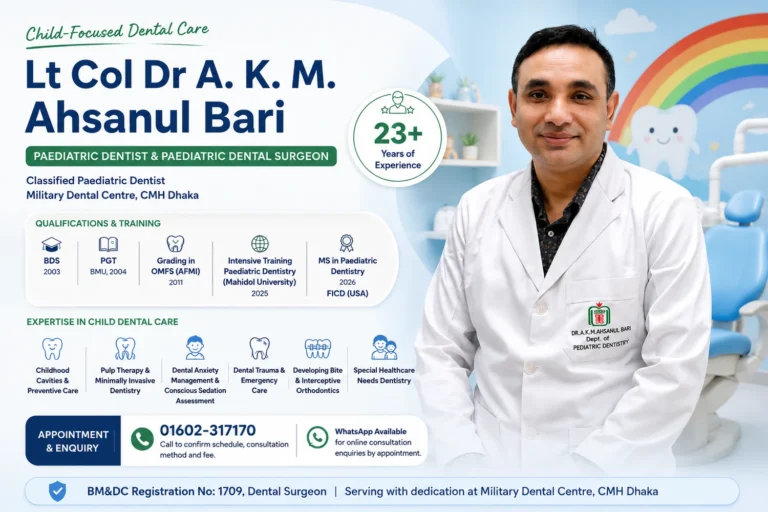
Lt Col Dr A. K. M. Ahsanul Bari – Paediatric Dentist in Dhaka
BDS, MS (Paediatric Dentistry), Grading in OMFS (AFMI), PGT (BMU), FICD (USA)
Classified Paediatric Dental Surgeon (Paedodontist), Military Dental Centre, CMH Dhaka
23 Years of Clinical Experience
Lt Col Dr A. K. M. Ahsanul Bari is an experienced paediatric dental surgeon, paedodontist, and maxillofacial specialist in Dhaka. He has 23 years of clinical experience in children’s oral healthcare, preventive dentistry, minimally invasive dental treatment, oral and maxillofacial surgery, and the management of children who require specialised dental support.
He currently serves as a Classified Paediatric Dental Surgeon (Paedodontist) at the Military Dental Centre, CMH Dhaka, Dhaka Cantonment. His professional approach combines extensive clinical experience, military healthcare discipline, postgraduate education, international training, and compassionate communication with children and their parents.
Dr Ahsanul Bari provides private consultation as a Paediatric Dental Surgeon and Maxillofacial Specialist at ODC Kids, ODC Health Cares, Green Road, Farmgate, Dhaka. Online dental consultation can also be arranged through Kids Care, Tangail, by prior appointment.
His mission is to provide compassionate, evidence-based, child-friendly dental care that helps children maintain healthy teeth while making each dental visit as positive, safe, and comfortable as possible.
About Lt Col Dr A. K. M. Ahsanul Bari
Lt Colonel Dr A. K. M. Ahsanul Bari has been working in dentistry since completing his Bachelor of Dental Surgery in 2003. During his 23-year professional journey, he has developed experience in children’s dentistry, oral and maxillofacial surgery, preventive dental care, dental trauma management, behaviour guidance, conscious sedation assessment, and treatment planning for children with special healthcare needs.
He has completed postgraduate and advanced professional training in Bangladesh, India, and Thailand. His international clinical exposure also includes working as a dental surgeon with the Kuwait Armed Forces.
His child-centred approach is especially helpful for children who:
- Are visiting a dentist for the first time
- Feel frightened or anxious about dental treatment
- Have painful or badly decayed teeth
- Have experienced dental trauma
- Need minimally invasive dental treatment
- Have autism, developmental delay, sensory sensitivity, or other special healthcare needs
- Require careful behavioural or sedation assessment
- Have developing bite or tooth-alignment concerns
Academic Qualifications
Dr Ahsanul Bari’s academic and postgraduate qualifications include:
- Bachelor of Dental Surgery—BDS, 2003
- Postgraduate Training—PGT, BMU, formerly PG Hospital, 2004
- Grading in Oral and Maxillofacial Surgery—OMFS, Armed Forces Medical Institute, 2011
- Master of Science—MS in Paediatric Dentistry, 2026
- FICD, USA
His combination of paediatric dental education and oral and maxillofacial surgery training supports the assessment and management of both routine and comparatively complex dental conditions affecting children.
Professional Training
Dr Ahsanul Bari has continued his professional development through advanced local and international training.
Conscious Sedation Training—India, 2024
He completed professional training in conscious sedation in India in 2024. Conscious sedation may be considered for carefully selected children who experience severe dental anxiety or cannot tolerate necessary treatment through routine behaviour-guidance techniques alone.
Sedation is not suitable for every child. A decision requires an assessment of the child’s age, health, medical history, behaviour, planned treatment, clinical facilities, monitoring requirements, and informed parental consent.
Intensive Paediatric Dentistry Training—Thailand, 2025
In 2025, he completed an Intensive Training Programme in Paediatric Dentistry and Dental Care for Children with Special Healthcare Needs at Mahidol University, Thailand.
This training strengthened his knowledge and skills in:
- Advanced child-focused dental care
- Behaviour management
- Preventive and minimally invasive treatment
- Managing anxious children
- Treating children with developmental or medical conditions
- Planning dental care for children who require extra support
- Communicating effectively with parents and caregivers
International Professional Experience
In 2016, Dr Ahsanul Bari worked as a Dental Surgeon at AFH, Kuwait Armed Forces.
This international professional experience added to his exposure to organised military healthcare, multidisciplinary treatment planning, clinical discipline, patient safety, and dental case management in an international setting.
Current Designation and Workplace
Designation: Classified Paediatric Dental Surgeon (Paedodontist)
Workplace: Military Dental Centre, CMH Dhaka
Location: Dhaka Cantonment, Dhaka
Dr Ahsanul Bari currently serves at the Military Dental Centre associated with CMH Dhaka. His institutional role focuses on paediatric dental care and the assessment and treatment of children’s oral health conditions.
Private patients should contact his listed chamber directly. Public consultation availability at CMH Dhaka has not been stated, and parents should not attend the military facility without appropriate authorisation or a confirmed appointment.
Chamber Information of Lt Col Dr A. K. M. Ahsanul Bari
Dhaka Chamber
- Chamber Name: ODC Kids, ODC Health Cares
- Doctor’s Chamber Designation: Paediatric Dentist/Pedodontist
- Address: Room 117–118, 1st Floor, R H Home Center, 74/B/1 Green Road, Farmgate, Dhaka–1215
- Visiting Days: Saturday–Thursday
- Visiting Hours: 5:30 PM–8:30 PM
- Doctor’s Appointment Number: 01602-317170
- Clinic Hotline: 01777-515333
- Consultation Type: In-person consultation by prior appointment
- Consultation Fee: Please confirm while booking
- Get Directions to ODC Kids, Dhaka
ODC Health Cares officially lists Lt Col Dr A. K. M. Ahsanul Bari as a Paediatric Dentist/Pedodontist. The clinic’s official contact information confirms its location at R H Home Center on Green Road and the clinic hotline listed above.
Parents should call before travelling to confirm the doctor’s availability, appointment time, and consultation fee, as schedules may occasionally change due to institutional responsibilities, emergencies, or public holidays.
Tangail Chamber
- Chamber Name: Kids Care
- Address: 447, Government Boys’ Orphanage Gate, Kazipur Road, Beparipara, Tangail Town, Tangail
- Consultation Type: In-person and online consultation by prior appointment
- Appointment Number: 01602-317170
- Visiting Hours: Available on appointment
- Consultation Fee: Please confirm while booking
- Get Directions to Kids Care, Tangail
Patients in Tangail may arrange either an in-person visit or an online dental consultation with Lt Col Dr A. K. M. Ahsanul Bari through Kids Care. Prior booking is required because consultations are provided according to appointment availability.
Online Dental Consultation
Online dental consultation is available by prior appointment through Kids Care, Tangail.
- To arrange an online consultation, call: 01602-317170
- Patients may also contact the appointment number through WhatsApp where the service is actively monitored: WhatsApp: 01602-317170
Online consultation may be useful for an initial discussion, follow-up guidance, review of dental reports, or assessment of visible symptoms. However, many dental conditions require an in-person examination, dental imaging, or physical treatment before a confirmed diagnosis and treatment plan can be provided.
BM&DC Registration
- Registration Authority: Bangladesh Medical & Dental Council
- BM&DC Registration Number: 1709
- Registration Category: Dental Surgeon
- Professional Experience: 23 years
Why Parents May Consult a Paediatric Dentist
Children’s teeth, behaviour, communication needs, growth patterns, and responses to treatment are different from those of adults. A paediatric dentist is trained to evaluate these age-specific needs and make dental visits more manageable for both the child and the family.
Parents may consider consulting a paediatric dentist when a child has:
- Toothache or sensitivity
- Visible cavities or dark spots on a tooth
- Broken, chipped, or injured teeth
- Swelling of the gum or face
- Difficulty chewing
- Early loss of baby teeth
- Delayed or unusual tooth eruption
- Fear of dental treatment
- Repeated dental infections
- Irregular tooth alignment or bite concerns
- Oral habits such as prolonged thumb sucking
- Medical, developmental, behavioural, or sensory conditions that affect dental care
Early assessment can help identify problems before they become more painful or require complex treatment.
Oral diseases are a major public-health concern in Bangladesh. In February 2026, the World Health Organization reported that more than 80% of people in Bangladesh were affected by at least one oral disease, while 71% of surveyed people said they had never received dental care.
Clinical Expertise and Areas of Interest
Dr Ahsanul Bari’s reported clinical interests cover preventive, restorative, behavioural, and child-focused dental care.
Preventive Dentistry for Children
Preventive dental care aims to reduce the likelihood of cavities, gum problems, dental pain, and avoidable tooth loss. Depending on the child’s age and oral condition, preventive care may include:
- Dental examinations
- Oral hygiene guidance
- Brushing instruction
- Dietary counselling
- Fluoride-based preventive care
- Fissure sealant assessment
- Monitoring the development of baby and permanent teeth
- Regular follow-up for children at higher risk of cavities
The World Health Organization states that most oral health conditions are largely preventable and can be treated more effectively when identified early.
Early Childhood Caries
Early childhood caries refers to tooth decay occurring in babies, toddlers, and preschool-aged children. It may begin as white, brown, or black marks and can gradually lead to pain, infection, difficulty eating, disturbed sleep, and anxiety.
Children who frequently consume sweetened drinks, biscuits, chocolates, juice, sticky snacks, or milk containing added sugar may face a higher risk, particularly when teeth are not cleaned properly before sleep.
WHO explains that oral bacteria use free sugars in foods and drinks to produce acids that gradually damage the tooth surface.
A Bangladeshi study involving schoolchildren in Mymensingh found a high burden of dental caries, reinforcing the need for earlier prevention and timely dental assessment among children.
Pulp Therapy and Treatment of Infected Baby Teeth
When decay reaches the inner part of a baby tooth, a child may develop pain, sensitivity, swelling, or infection. Pulp therapy is intended to treat or preserve an affected tooth when clinically appropriate.
Treatment is selected after examining factors such as:
- The depth of decay
- The condition of the tooth nerve
- The presence of infection
- The child’s age
- The tooth’s expected natural shedding time
- The child’s ability to cooperate
- The importance of preserving space for the permanent tooth
Not every painful or decayed tooth requires the same procedure. A clinical examination and, where necessary, dental imaging are needed before a treatment decision can be made.
Hall Technique and Minimally Invasive Dentistry
The Hall Technique is a child-focused approach that may be considered for selected decayed baby molars. It generally involves sealing the affected tooth beneath a preformed metal crown without removing decay in the conventional way.
Minimally invasive dentistry aims to preserve as much healthy tooth structure as possible while controlling disease. Suitability depends on the individual tooth, symptoms, extent of decay, infection status, and the dentist’s clinical assessment.
Dental Anxiety and Behaviour Guidance
Some children become frightened by unfamiliar people, dental instruments, sounds, smells, or previous painful experiences. Others may find it difficult to sit still or follow instructions during treatment.
Behaviour guidance may include:
- Age-appropriate explanations
- Gradual introduction to the dental environment
- Tell-show-do techniques
- Positive reinforcement
- Shorter appointments
- Parent counselling
- Step-by-step treatment planning
- Familiarisation visits before treatment
Parents should inform the dentist about previous negative dental experiences, developmental concerns, sensory sensitivities, attention difficulties, communication needs, or known triggers before the visit.
Conscious Sedation Assessment
Dr Ahsanul Bari has reported training in conscious sedation. Sedation may be considered for selected children who experience significant dental anxiety or difficulty tolerating necessary treatment.
Sedation is not automatically appropriate for every fearful child. The decision depends on the child’s health, age, behaviour, planned procedure, fasting requirements, medical history, clinical setting, monitoring facilities, and informed consent.
Parents should provide complete information about:
- Current medicines
- Allergies
- Asthma
- Heart conditions
- Seizure history
- Previous anaesthesia or sedation
- Respiratory illness
- Recent fever, cough, or infection
- Any diagnosed medical or developmental condition
The final sedation plan should only be made after a direct professional assessment.
Children with Special Healthcare Needs
Children with autism, cerebral palsy, Down syndrome, developmental delay, sensory processing differences, intellectual disabilities, chronic medical conditions, or communication difficulties may need additional planning during dental care.
Dr Ahsanul Bari’s reported training includes dental care for children with special healthcare needs. Depending on the child, appointments may involve:
- Additional preparation time
- A quieter or more gradual visit
- Adjusted communication
- Caregiver participation
- Shorter treatment sessions
- Desensitisation
- Coordination with other healthcare professionals
- Assessment for advanced behaviour-management support
Parents should discuss the child’s routine, communication preferences, medications, previous dental experiences, and specific triggers when booking.
Dental Trauma
Children may injure their teeth while playing, cycling, running, participating in sports, or falling at home or school.
Urgent dental assessment may be needed when:
- A permanent tooth is knocked out
- A tooth becomes loose or displaced
- A tooth breaks
- There is heavy bleeding
- The lip, tongue, or gum is deeply injured
- The child cannot bite normally
- Swelling or severe pain develops
- A tooth becomes darker after an injury
A knocked-out permanent tooth is time-sensitive. Parents should seek urgent dental care immediately. A knocked-out baby tooth should not be pushed back into the socket unless specifically instructed by a qualified dental professional.
Interceptive Orthodontic Assessment
Interceptive orthodontics involves identifying developing bite or alignment problems while the child is still growing.
Assessment may be useful for:
- Crowded teeth
- Early or delayed loss of baby teeth
- Protruding front teeth
- Crossbite
- Underbite
- Open bite
- Abnormal jaw development
- Persistent thumb sucking
- Mouth breathing
- Difficulty biting or chewing
Not every child requires early orthodontic treatment. Some conditions are observed over time, while others may benefit from intervention during a particular stage of growth.
Oral and Maxillofacial Surgery Assessment
Dr Ahsanul Bari has reported grading in Oral and Maxillofacial Surgery from AFMI. This background may support the initial assessment of dental infections, impacted teeth, oral injuries, jaw-related symptoms, and conditions that may require surgical referral.
Complex procedures may require referral to an oral and maxillofacial surgeon, hospital, or multidisciplinary team depending on the diagnosis.
What Parents Can Expect During a Consultation
During the first appointment, the dentist may ask about:
- The child’s current symptoms
- When the problem began
- Previous dental treatment
- Brushing habits
- Dietary habits
- Medical conditions
- Allergies
- Current medications
- Past hospitalisation or surgery
- Behavioural or developmental needs
- Previous experiences with sedation or anaesthesia
The child’s mouth, teeth, gums, bite, and oral development may then be examined. Dental X-rays or other investigations may be advised when clinically necessary.
After assessment, the parent should receive an explanation of the likely diagnosis, available treatment options, possible risks, expected number of visits, aftercare needs, and estimated costs.
Treatment recommendations vary between children. Information on this profile should not be used as a substitute for an individual clinical examination.
When Should a Child First Visit a Dentist?
A child should ideally become familiar with dental care from an early age rather than waiting for severe pain. Early visits allow parents to receive guidance about brushing, feeding habits, fluoride, teething, bottle use, and cavity prevention.
Parents should arrange an earlier appointment when a child has visible decay, toothache, swelling, dental injury, difficulty eating, or unusual tooth development.
Preparing Your Child for a Dental Visit
Parents can make the appointment easier by:
- Using positive and simple language
- Avoiding frightening words or stories
- Not promising that treatment will be completely painless
- Bringing relevant prescriptions or medical reports
- Arriving before the scheduled time
- Following any fasting instructions exactly
- Carrying the child’s preferred comfort item when appropriate
- Informing the clinic about behavioural or sensory needs in advance
For online consultations, parents may be asked to provide clear photographs, medical information, or previous dental reports. Online consultation can support initial guidance and follow-up, but some dental conditions cannot be diagnosed or treated without an in-person examination.
Frequently Asked Questions
How can parents book an appointment with Dr Ahsanul Bari?
For consultation at ODC Kids, ODC Health Cares, parents can call 01602-317170 or the clinic hotline 01777-515333. The Dhaka chamber operates Saturday–Thursday from 5:30 PM–8:30 PM by prior appointment. For Kids Care, Tangail, call 01602-317170 to arrange an in-person or online consultation.
Where is Dr Ahsanul Bari’s Dhaka chamber?
His Dhaka chamber is at ODC Kids, ODC Health Cares, Rooms 117–118, 1st Floor, R H Home Center, 74/B/1 Green Road, Farmgate, Dhaka–1215. In-person consultation is available by prior appointment from Saturday to Thursday, 5:30 PM–8:30 PM.
Does Dr Ahsanul Bari provide in-person consultation in Tangail?
Yes. According to the doctor-provided information, both in-person and online consultation are available through Kids Care, Tangail, by prior appointment. Parents should call 01602-317170 before travelling to confirm the date, time, consultation format and fee.
What information should parents provide when booking?
Parents should mention the child’s age, main dental concern, duration of symptoms and whether there is pain, swelling, fever, bleeding or a recent injury. They should also disclose allergies, regular medicines, medical conditions, developmental needs, sensory concerns and any previous difficulty receiving dental treatment.
How can parents prepare an anxious child for a dental visit?
Describe the visit in simple, positive language and avoid frightening words or promises that treatment will be completely painless. Parents can say that the dentist will examine and count the teeth. A familiar comfort item may help. The dentist may use explanation, demonstration, praise, distraction and gradual familiarisation.
Can the first appointment be used only for familiarisation?
Parents may request an assessment or familiarisation-focused first visit. Whether treatment is carried out immediately depends on the urgency of the condition, the child’s symptoms, ability to cooperate and the dentist’s clinical assessment. Severe pain, infection or trauma may require more immediate treatment planning.
Will every anxious child receive conscious sedation?
No. Conscious sedation is considered only after reviewing the child’s age, medical history, development, dental needs, anxiety and response to basic behaviour-guidance methods. Appropriate facilities, monitoring and informed parental consent are also required. Parents should confirm whether sedation is available and suitable for the proposed treatment.
Can Dr Bari assess a child who could not complete treatment elsewhere?
Yes. Parents can arrange an assessment and explain what happened during the earlier appointment. The consultation can review the child’s dental condition, anxiety, age, medical history and cooperation. The child may need a different communication method, gradual introduction, staged treatment or a more specialised setting.
What should parents do if a child breaks or knocks out a tooth?
Seek urgent dental advice. Hold a knocked-out permanent tooth by the crown and avoid touching or scrubbing the root. Do not push a knocked-out baby tooth back into its socket. Bring any recovered tooth or broken fragment to the consultation. Prompt assessment can affect the outcome.
Is online consultation enough for facial swelling?
Online consultation may offer initial guidance, but facial swelling usually requires prompt in-person assessment. Seek urgent care if swelling is increasing or accompanied by fever, weakness, difficulty opening the mouth, swallowing difficulty or breathing problems. Online advice should not delay emergency care.
Book an Appointment
Parents seeking a paediatric dentist in Dhaka may consult Lt Col Dr A. K. M. Ahsanul Bari regarding childhood cavities, dental pain, dental infection, dental anxiety, dental trauma, preventive care, pulp therapy, special healthcare needs, bite development, or other paediatric dental concerns.
- For an appointment at ODC Kids, Green Road, Dhaka, or an online consultation through Kids Care, Tangail, call: 01602-317170
- Patients may also contact the ODC Health Cares clinic hotline: 01777-515333
Please confirm the doctor’s visiting schedule, consultation fee, appointment availability, and consultation method before visiting.
Medical Disclaimer
This profile is provided for general information and appointment support. It does not replace a direct dental examination, diagnosis, treatment plan, prescription, or emergency service.
Seek urgent medical or dental care if a child develops severe facial swelling, uncontrolled bleeding, difficulty breathing or swallowing, major facial injury, rapidly worsening infection, high fever with dental symptoms, or a knocked-out permanent tooth.