

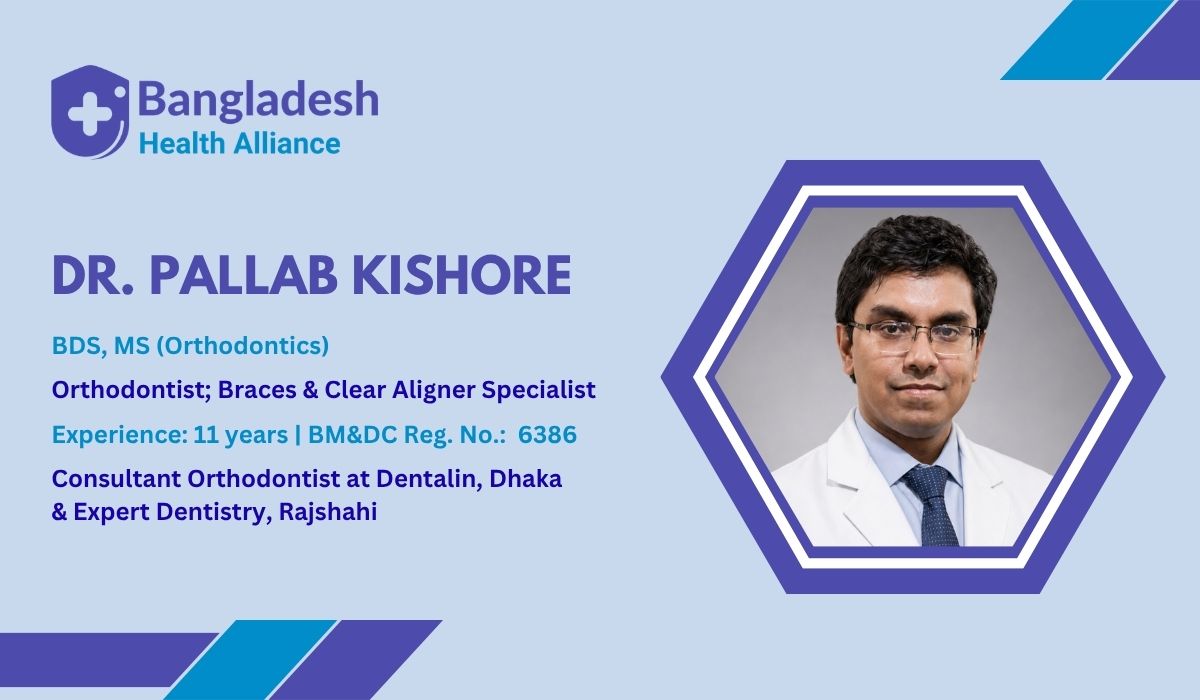
Dr. Pallab Kishore – Orthodontist in Dhaka & Rajshahi
BDS, MS (Orthodontics) | Consultant Orthodontist | Braces & Clear Aligner Specialist | 11+ Years of Professional Experience
Dr. Pallab Kishore is a Consultant Orthodontist who provides orthodontic consultation for patients seeking assessment and treatment of crooked teeth, dental crowding, spacing, tooth alignment, braces, clear aligners, and other orthodontic concerns. He holds BDS and MS (Orthodontics) qualifications and has more than 11 years of professional experience.
He currently sees patients at Dentalin in Motijheel, Dhaka, and Expert Dentistry in Kadirganj, Rajshahi.
About Dr. Pallab Kishore
Dr. Pallab Kishore practices as a Consultant Orthodontist, with a professional focus on orthodontic assessment and treatment planning.
Orthodontics is the area of dentistry concerned with the position and alignment of teeth and how the upper and lower teeth meet. Patients commonly seek an orthodontic consultation when their teeth are crowded, crooked, protruding, unusually spaced, or when they are concerned about their bite.
Braces and clear aligners can both be used to move teeth gradually, but the most appropriate option depends on the individual patient. Tooth position, bite, available space, oral hygiene, gum health, age, treatment goals, and the complexity of the required tooth movement may all influence the treatment plan.
For patients searching for an orthodontist in Dhaka, an orthodontist in Rajshahi, a braces specialist, or a clear aligner specialist, an in-person assessment with an appropriately qualified dental professional is the first step toward understanding which treatment options may be suitable.
Educational Qualifications
Dr. Pallab Kishore’s listed professional qualifications are:
- BDS
- MS (Orthodontics)
A BDS provides the professional foundation for dental practice, while postgraduate study in orthodontics focuses more specifically on the diagnosis and management of tooth-position and bite-related problems.
Orthodontic assessment may involve examination of the teeth, bite, jaws, oral hygiene, and surrounding dental structures. Depending on the case, an orthodontist may also require dental photographs, scans, impressions, or X-rays before completing a treatment plan.
General NHS orthodontic guidance similarly notes that treatment planning depends on the individual dental problem and may involve assessment of the teeth and jaws before treatment begins.
Professional Experience
Dr. Pallab Kishore has more than 11 years of professional experience.
Orthodontic care often continues over a series of appointments rather than being completed in one visit. A treatment journey may include:
- Initial consultation and examination
- Diagnostic records when needed
- Treatment planning
- Placement or delivery of the orthodontic appliance
- Periodic monitoring
- Adjustments or progression through aligners
- Oral-hygiene guidance
- Retention after active treatment
The total treatment period varies between patients. It may be influenced by the type and severity of the orthodontic problem, the appliance being used, oral health, biological response, and how closely treatment instructions are followed.
Dr. Pallab Kishore’s Dhaka Chamber
Dentalin, Motijheel, Dhaka
Patients looking for an orthodontist in Motijheel or Dhaka can consult Dr. Pallab Kishore at Dentalin.
Clinic: Dentalin
Address: 1st Floor, Plot 18, Sadek Hossain Khoka Road, Motijheel, Dhaka
Visiting Days: Tuesday to Thursday
Visiting Hours: 4:00 PM – 9:00 PM
Appointment Number: 01313-660033
Consultation Fee: BDT 1,000, as currently provided
Call for appointment: 01313-660033
Visiting schedules and consultation fees may change. Patients, especially those travelling from outside central Dhaka, should call before starting their journey.
Patients comparing other orthodontic services in the capital can also explore BHA’s guide to orthodontists and braces specialists in Dhaka. Orthodontists and Braces Specialists in Dhaka
Dr. Pallab Kishore’s Rajshahi Chamber
Expert Dentistry, Kadirganj, Rajshahi
Dr. Pallab Kishore also sees patients at Expert Dentistry in Rajshahi.
Clinic: Expert Dentistry
Address: 286/A, Kadirganj, 2nd Floor of Tasty Treat, opposite Nazmul Huq School, Rajshahi
Visiting Days: Saturday to Monday
Visiting Hours: 4:00 PM – 9:00 PM
Appointment Number: 01410-421100
Consultation Fee: BDT 1,000, as currently provided
Call for appointment: 01410-421100
Patients travelling from outside Rajshahi city should confirm the latest schedule and fee before visiting.
For broader local doctor discovery, BHA also maintains a guide to dental specialists in Rajshahi. Dental Specialists in Rajshahi
Braces Treatment
Braces are a well-established method of gradually moving teeth into planned positions.
Fixed braces commonly use brackets attached to the teeth and wires that apply controlled forces over time. Orthodontic treatment may be considered when teeth are:
- Crooked
- Crowded
- Overlapping
- Protruding
- Rotated
- Widely spaced
- Positioned in a way that contributes to an abnormal bite
Current NHS guidance describes braces as a treatment used to straighten teeth and notes that they may be recommended when teeth are crowded, protruding, widely spaced, or when the upper and lower teeth or jaws do not meet properly.
Patients considering braces with Dr. Pallab Kishore can discuss the nature of their alignment problem, expected treatment approach, follow-up requirements, appliance care, and estimated costs before treatment begins.
For general information about expected treatment expenses, patients can also read Bangladesh Health Alliance’s guide to teeth braces cost in Bangladesh. Teeth Braces Cost in Bangladesh
Clear Aligner Treatment
Dr. Pallab Kishore’s listed specialty includes clear aligner treatment.
Clear aligners are removable transparent trays designed to move teeth gradually through a planned sequence. Their less noticeable appearance may appeal to patients who prefer an alternative to conventional visible braces.
Because aligners are removable, they can generally be taken out for meals and oral hygiene according to the orthodontist’s instructions. However, successful treatment depends heavily on consistent wear.
Clear aligners are not automatically suitable for every patient or every type of orthodontic movement. More complicated tooth positions or bite problems may require a different approach.
An orthodontic examination therefore remains important before deciding between clear aligners and fixed braces.
Braces vs Clear Aligners
Neither braces nor clear aligners are automatically “better.” The more suitable option depends on the patient’s orthodontic condition, treatment goals, and ability to follow appliance instructions.
| Factor | Fixed Braces | Clear Aligners |
|---|---|---|
| Visibility | Usually more noticeable | Usually less noticeable |
| Removable | No | Yes |
| Eating | Appliance stays on the teeth | Usually removed for meals as instructed |
| Cleaning | Requires careful cleaning around brackets and wires | Removed for brushing and tray cleaning |
| Patient responsibility | Appliance remains attached | Consistent wear is especially important |
| Suitability | Can be used for many orthodontic problems | Depends on type and complexity of tooth movement |
| Final decision | Requires orthodontic assessment | Requires orthodontic assessment |
Patients concerned mainly about appearance should still avoid choosing an appliance based only on visibility. Treatment effectiveness, oral health, comfort, lifestyle, treatment complexity, and long-term stability all matter.
Teeth Crowding, Crooked Teeth and Spacing
Dental crowding occurs when there is not enough room for teeth to remain in an orderly position. Teeth may overlap, rotate, or erupt outside the preferred dental arch.
Spacing describes visible gaps between teeth. The cause of spacing can differ from one patient to another.
Both problems may be reasons to seek an orthodontic assessment, but treatment should be based on more than cosmetic appearance. The relationship between the teeth, bite, gum health, available space, and overall dental condition needs to be considered.
Patients should also mention any previous braces treatment, tooth extractions, dental trauma, or other significant dental history during their consultation.
Bite-Related Orthodontic Concerns
Some patients seek orthodontic care because their upper and lower teeth do not meet in the way they expect.
Terms commonly used in orthodontics include:
- Overbite
- Underbite
- Crossbite
- Open bite
These terms can describe different dental relationships and should not be self-diagnosed from photographs alone.
Patients concerned about their bite can consult an orthodontist for assessment. The recommended treatment, if any, depends on the individual clinical findings.
Can Adults Have Orthodontic Treatment?
Yes. Adults can receive orthodontic treatment when their dental and gum health is suitable.
NHS guidance states that orthodontic treatment for adults can begin at any age, although maintaining good oral hygiene is important because orthodontic appliances can increase the risk of tooth decay and gum problems if cleaning is inadequate.
Adult orthodontic planning may also need to consider:
- Existing fillings or crowns
- Missing teeth
- Previous dental treatment
- Gum condition
- Previous orthodontic treatment
- Current oral-hygiene status
Patients should therefore expect an individualized assessment rather than assuming that a treatment option suitable for another person will also be suitable for them.
When Should You See an Orthodontist?
Consider an orthodontic consultation if you are concerned about:
- Crooked or overlapping teeth
- Crowded teeth
- Noticeable gaps
- Protruding teeth
- Rotated or displaced teeth
- Upper and lower teeth not meeting normally
- Difficulty cleaning certain areas because of tooth position
- Changes in tooth alignment after previous orthodontic treatment
- The appearance or function of your dental alignment
An orthodontist can assess whether treatment is needed and explain the available options.
Why Oral Hygiene Matters During Orthodontic Treatment
Good oral hygiene is essential before and during orthodontic treatment.
Fixed braces can create additional areas where food and plaque collect, while patients using removable appliances also need to keep both their teeth and appliances clean.
Current NHS guidance advises people with braces to maintain careful brushing, clean around the appliance, and continue routine dental check-ups during orthodontic treatment. It also notes that poor plaque control can contribute to tooth decay and gum problems.
Patients should follow the oral-hygiene instructions given by their dental and orthodontic team throughout treatment.
Oral Health in Bangladesh
The wider oral-health situation in Bangladesh makes preventive dental care particularly important.
In February 2026, the World Health Organization reported that more than 80% of Bangladesh’s population is affected by at least one oral disease, while 71% of people surveyed said they had never received any form of dental care. WHO also reported the endorsement of Bangladesh’s first National Oral Health Strategy and Action Plan 2025–2030.
WHO’s Bangladesh Oral Health Country Profile also estimated that, in 2019, 30.4% of people aged five years and older had untreated caries in permanent teeth, while 23.4% of people aged 15 years and older had severe periodontal disease.
These national figures do not describe Dr. Pallab Kishore’s individual patients. They are included to provide broader context on the importance of oral-health assessment and timely dental care in Bangladesh.
What to Bring to Your First Orthodontic Appointment
To help make the consultation more useful, bring any previous dental information you already have, such as:
- Dental X-rays
- Previous orthodontic records
- Dental prescriptions
- Information about earlier braces or retainers
- Relevant treatment summaries
- Details of previous dental trauma or extractions
Existing records may provide useful background, although new photographs, scans, X-rays, or other investigations may still be required if clinically appropriate.
It can also help to write down the main reason you are seeking treatment and any questions you would like answered.
Useful Questions to Ask Before Starting Treatment
Before agreeing to orthodontic treatment, consider asking:
- What orthodontic problem has been identified?
- What treatment options are suitable for my case?
- Why is the recommended appliance preferred?
- How often will follow-up visits be required?
- What oral-hygiene changes will I need to make?
- What factors may affect the treatment duration?
- Will I need a retainer afterward?
- What is included in the estimated treatment cost?
- Are diagnostic tests or additional procedures charged separately?
Clear communication about expectations can help patients make informed treatment decisions.
BM&DC Registration Information
According to the professional information provided for this profile, Dr. Pallab Kishore’s BM&DC registration number is 6386.
The Bangladesh Medical & Dental Council (BM&DC) is the statutory body responsible for registering doctors to practice in Bangladesh and for maintaining standards related to medical and dental education and professional practice.
Patients who want to independently check practitioner information should use the official BM&DC doctor-search or registration services.
Frequently Asked Questions About Dr. Pallab Kishore
Can Dr. Pallab Kishore help me decide between braces and clear aligners?
Yes. Dr. Pallab Kishore is a Consultant Orthodontist whose listed specialty includes braces and clear aligners. During an orthodontic assessment, factors such as tooth position, crowding, spacing, bite, oral health, and the complexity of the required tooth movement can be considered before a treatment option is recommended.
Clear aligners may suit some patients, while fixed braces may be more appropriate for others. Neither option should be selected only because of appearance or convenience.
Will Dr. Pallab Kishore start my braces treatment during the first appointment?
Not necessarily. The first appointment may focus on examining your teeth and bite, discussing your concerns, and deciding whether further diagnostic information is needed.
Depending on the case, photographs, scans, impressions, or dental X-rays may be required before a complete treatment plan can be prepared. Treatment can then be discussed in terms of the appliance, expected follow-up, oral-hygiene requirements, possible duration, and cost.
Can I bring an old dental X-ray when I visit Dr. Pallab Kishore?
Yes. If you already have dental X-rays, previous orthodontic records, scans, prescriptions, or treatment summaries, bring them with you.
Previous records can provide useful background about earlier dental or orthodontic treatment. However, an old X-ray may not always provide all the information needed for a new treatment plan, so Dr. Pallab Kishore may recommend updated records if they are clinically necessary.
Can adults consult Dr. Pallab Kishore for braces or clear aligners?
Yes. Adults concerned about crooked teeth, crowding, spacing, or tooth alignment can arrange an orthodontic assessment with Dr. Pallab Kishore.
Orthodontic treatment is not limited to children or teenagers. NHS guidance states that adult orthodontic treatment can begin at any age. Good dental and gum health remains important because patients need to maintain effective oral hygiene throughout orthodontic treatment.
The appropriate treatment option depends on each adult patient’s dental condition and treatment goals.
How often will I need follow-up appointments after starting orthodontic treatment?
Follow-up appointments are generally required throughout active orthodontic treatment, but the interval varies according to the appliance, treatment stage, tooth movement, and individual treatment plan.
For example, current NHS guidance notes that patients with fixed braces may have adjustment appointments approximately every several weeks.
Dr. Pallab Kishore can explain the expected review schedule for your specific case before or after treatment begins. Patients travelling from another district should consider follow-up requirements when planning treatment.
What should I do if my brace or wire breaks between appointments?
Contact the chamber where you are receiving orthodontic treatment and explain what has broken and whether you are experiencing pain or irritation.
Do not automatically wait until the next routine visit if the appliance is damaged. NHS guidance advises patients to contact their orthodontic team if braces break or if significant discomfort persists.
The chamber can advise whether you need an earlier appointment or another appropriate next step.
Can I remove clear aligners whenever I want?
Clear aligners are removable, but they should not be treated as an appliance that can be worn only occasionally.
To move teeth according to the treatment plan, patients normally need to follow the orthodontist’s prescribed wear schedule carefully. Aligners may be removed at appropriate times, such as for eating and oral hygiene, according to the instructions given for that specific treatment system.
Before starting, ask Dr. Pallab Kishore how consistently you will need to wear the aligners and what may happen if the recommended schedule is not followed.
Will I need a retainer after braces or clear aligner treatment?
Retention is commonly required after active orthodontic tooth movement.
A retainer helps maintain the corrected tooth position while the surrounding tissues adapt. Without appropriate retention, teeth can move again over time.
NHS orthodontic guidance advises that retainers are used after braces to reduce the risk of teeth moving back toward their previous positions.
The type of retainer and how long it should be worn depend on the individual treatment plan, so patients should follow the instructions given after treatment.
Should I continue regular dental check-ups while Dr. Pallab Kishore is managing my braces?
Yes. Orthodontic follow-up and routine dental care have different purposes.
An orthodontic appointment primarily monitors tooth movement, bite, and the appliance, while general dental check-ups remain important for identifying tooth decay, gum problems, and other oral-health conditions.
Current NHS guidance specifically advises patients to continue regular dental check-ups while wearing braces and to maintain careful cleaning around the teeth and appliance.
This is especially important because plaque can accumulate more easily around fixed orthodontic appliances.
What should I ask Dr. Pallab Kishore before agreeing to braces or clear aligner treatment?
Ask for a clear explanation of:
- Your orthodontic diagnosis
- The treatment options suitable for your case
- Why a particular appliance is being recommended
- Expected follow-up requirements
- Factors that may affect treatment duration
- Oral-hygiene instructions
- Whether retention will be required
- Estimated treatment costs
- Whether investigations or additional procedures are charged separately
You may also ask what the likely consequences are if treatment is delayed or not undertaken.
Understanding the treatment plan before starting can help you make a more informed decision and understand your responsibilities during orthodontic care.
Book an Appointment with Dr. Pallab Kishore
For orthodontic consultation in Dhaka, contact:
Dentalin, Motijheel
01313-660033
Tuesday to Thursday, 4:00 PM – 9:00 PM
For orthodontic consultation in Rajshahi, contact:
Expert Dentistry, Kadirganj
01410-421100
Saturday to Monday, 4:00 PM – 9:00 PM
The currently provided consultation fee is BDT 1,000.
Online consultation is not currently listed as available.
Patients should call the relevant chamber to confirm the doctor’s current visiting schedule, consultation fee, and appointment availability before travelling.
Medical Information Notice
This profile is intended to help patients understand Dr. Pallab Kishore’s professional information, chamber schedule, and general orthodontic care. It does not replace an in-person dental examination, diagnosis, or individualized treatment advice.
The suitability of braces, clear aligners, or any other orthodontic treatment must be determined after appropriate clinical assessment.
Sources
- World Health Organization — Bangladesh National Oral Health Strategy and Action Plan 2025–2030.
- World Health Organization — Oral Health Bangladesh 2022 Country Profile.
- Bangladesh Medical & Dental Council — Official professional-registration information.
- NHS — Braces and orthodontic-care guidance.